
My new cringe blog
Hi, my name's Marco and this is my brand-new blog, and the reason for this blog post is to tell you only the truth.
Blogging is fucking cringe!
Now, what I want to ask you is to contain your rage till the end, then you will draw your conclusions.
To start explaining my thesis, I think that—as every mediocre YouTuber storyteller teaches us—we should “start from the beginning.”
The Exploration Era

At the beginning, the Internet was empty, a place entirely new to be discovered.
Bloggers were not that different from old explorers, trying their best to find new lands but, instead of finding new countries, they were creating their own little ones.
Creating a blog is a bit like creating the worst nation that could exist:
- Your own rules
- Everyone can enter
- Everyone can comment
- A place to share experiences
- With a dictator ruling it (the reason it’s not a good country)
I think that in this time, from the early 1990s to the 2010s, some of the best people in the world started filling the internet with knowledge and passion. To this day I read a lot of blogs that are closed and abandoned, and the amount of quality in them is endless.
Essayists like my father (Italian meme) Paul Graham, or classic tech bloggers like Simon Willison, were just some beautiful chords in a sea of noise. The majority of content creators were people yapping about their useless life and passions. This last category of people is the cause of Cringe Blogging.
Day after day people were starting to get tired of the mass production of useless websites created only for the owner to read their beautiful posts about the colorful flower they saw walking back home. As you can easily imagine, the Golden Era of blogs was coming to an end.
Social networks started incorporating the “noise blogging” into one single platform. If one day you used to journal on a website, reaching few people, with social networks you could, on a daily basis, reach ideally everyone — and with less effort.
Days passed and the “cringe” started to shift to other platforms, and the web was losing its charm.
People began dismissing their websites, and daily blog posts turned into Facebook posts or tweets. People were tired of weird handmade pages.
The Colonialism Era was coming.
Maybe all that cringe… wasn’t that bad.
Colonialism

We’re in the late ’10s and the Internet Bubble is an old memory and another crisis has passed. The world is a beautiful place: welcome to the Imperialism Era.
These days the world has faced something never seen before. Tech was becoming the leading industry of the world and was made by nerds hungry to innovate.
We were used to evil corporations making money in ways that were questionable; this time it felt different. Google’s motto was “Don’t be evil,” Facebook was one of the best places to work, and Silicon Valley was becoming the place for people who wanted heaven to be a place on Earth.
FAANG had become the leader of a beautiful colonialism of the web.
In the colonialism era, you don’t need to write your own website from scratch, learn to code or design just for the purpose of communication. FAANG wants to make your life easier: they own the platforms, so it’s easier for you to reach people, connect with them, and—why not—make even some pennies.
So for “normal people,” blogging was transformed into vlogging, tweeting, or posting (on a social network). And what about the others?
The “others,” the people who used to take blogging seriously, needed to find a way to earn something from it. As we talked about in my previous post Famous ≠ Rich, if you’re famous you need to convert those followers into numbers. Only a few continued to blog as a hobby or for other purposes; the majority started doing it professionally.
Rise of the Pro-Blogger
We said there were people with an audience who needed to convert it into money. For a blogger there are two ways:
- ADS
- PROMOTIONS
There’s a slight difference: ads are the classic banner ads; promotions are companies paying the blogger for reviews and similar things. We’ll call them both “ads.”
So yes, there was finally a way to make a living from writing. Beautiful, right?!
Well, not really.
What happened is that bloggers, now using their websites to live, shifted into garbage collectors of click-bait posts. The real purpose was no longer to share knowledge; the purpose of blogging became reaching as many people as possible.
This disease continues to this day, where it’s impossible not to read a blog post (on top of every Google search due to SEO optimization) trying to sell you something in the most politically correct and clean way.
Try to find some gift advice on Google and enjoy the dropshipping shit.
No Place to Be
So here we are today. There is no place to “be” on the Internet. Your existence depends on a platform that has the only purpose of making as much money as it can, limiting your freedom of speech, constraining you in their algorithms, not letting you open your mind. Bloggers have become no different from TikTok influencers chasing the last trend—the only difference being that the “trend” is whatever people search on Google.
There is no place to share daily thoughts, new things to discover; everything is homogenized and there is no space for creativity.
Maybe that cringe blogging wasn’t that bad…
Wait a moment, sure, I got the answer!
Blogging MUST be cringe.
Blogging — A New Hope
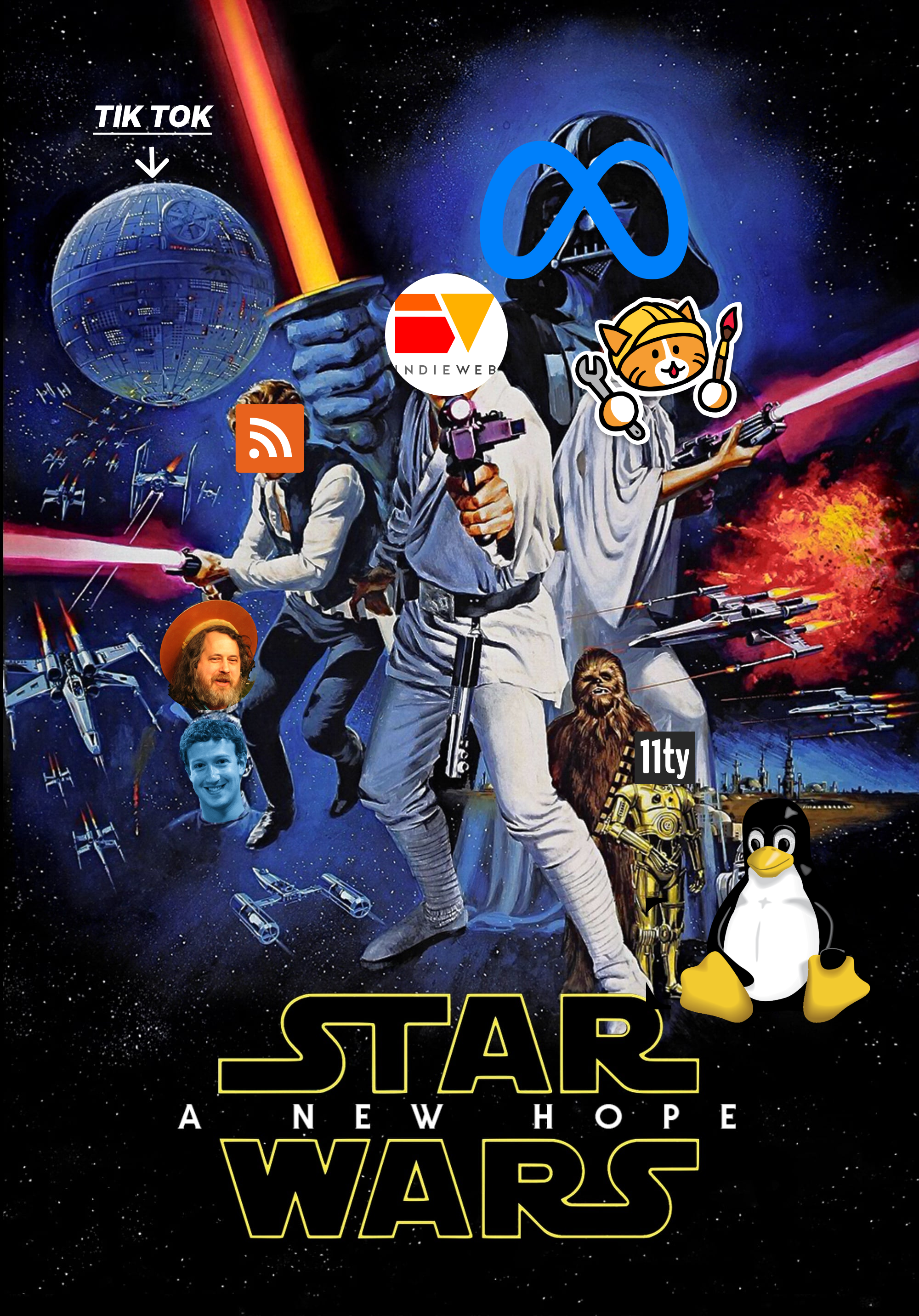
After modern Internet colonialism, many people started feeling the need to become more independent from Big Tech and its dynamics. People began creating their own sites and sharing them as a sort of business card.
A new movement was born: the Indie Web.
From indieweb.com
The IndieWeb is a people-focused alternative to the “corporate web”.
We are a community of independent and personal websites, based on the principles of: owning your domain and using it as your primary online identity, publishing on your own site first (optionally elsewhere), and owning your content.
In short:
- Own your content
- Control your content
- Be free
So yes, people have returned to blogging, and that’s great, but we just said that to blog you need to be cringe… is that really true?
Let’s think for a moment about what people consider cringe. People used to “cringe” at old blogs for one main reason: they didn’t give a fuck.
This, in my opinion, is what caused the downfall of the first wave of blogging: people stopped caring.
So why blog if people don’t care about you?
Because you must do it for yourself.
Something I’ve noticed is that real bloggers don’t write for others—or at least they don’t need others. They do it because they love it. If you fall into the trap of “I need to become famous,” you become a slave to the system, trying to write as little as possible, not improving your skills.
Share your passion, write about what you really care about, and people will start following you. We’re a niche. Of course people will find you cringe, but they’re not your goal. You need to connect with the people who are right for you—and there’s a chance that no one fits you. And that’s the beauty of a free space: everyone is free to talk and free to listen.
So with this blog post I just wanted to present my way of talking, my ideology, and my mission with this blog. I’ll probably make more technical posts about coding and tech but, as Paul Graham teaches, a hacker is someone with the creativity and critical thinking to see the world from new perspectives (a bit of a paraphrase).
So, my little Blognaut, one last word:
be cringe and JOIN THE RESISTANCE.